Choosing a Robot Vacuum for Hard Floors and Rugs
Suction is the easiest number to advertise and the least useful one to compare. Start with clearance, dock space and how the mop handles a rug.
Affiliate disclosure: This guide contains no active affiliate links.
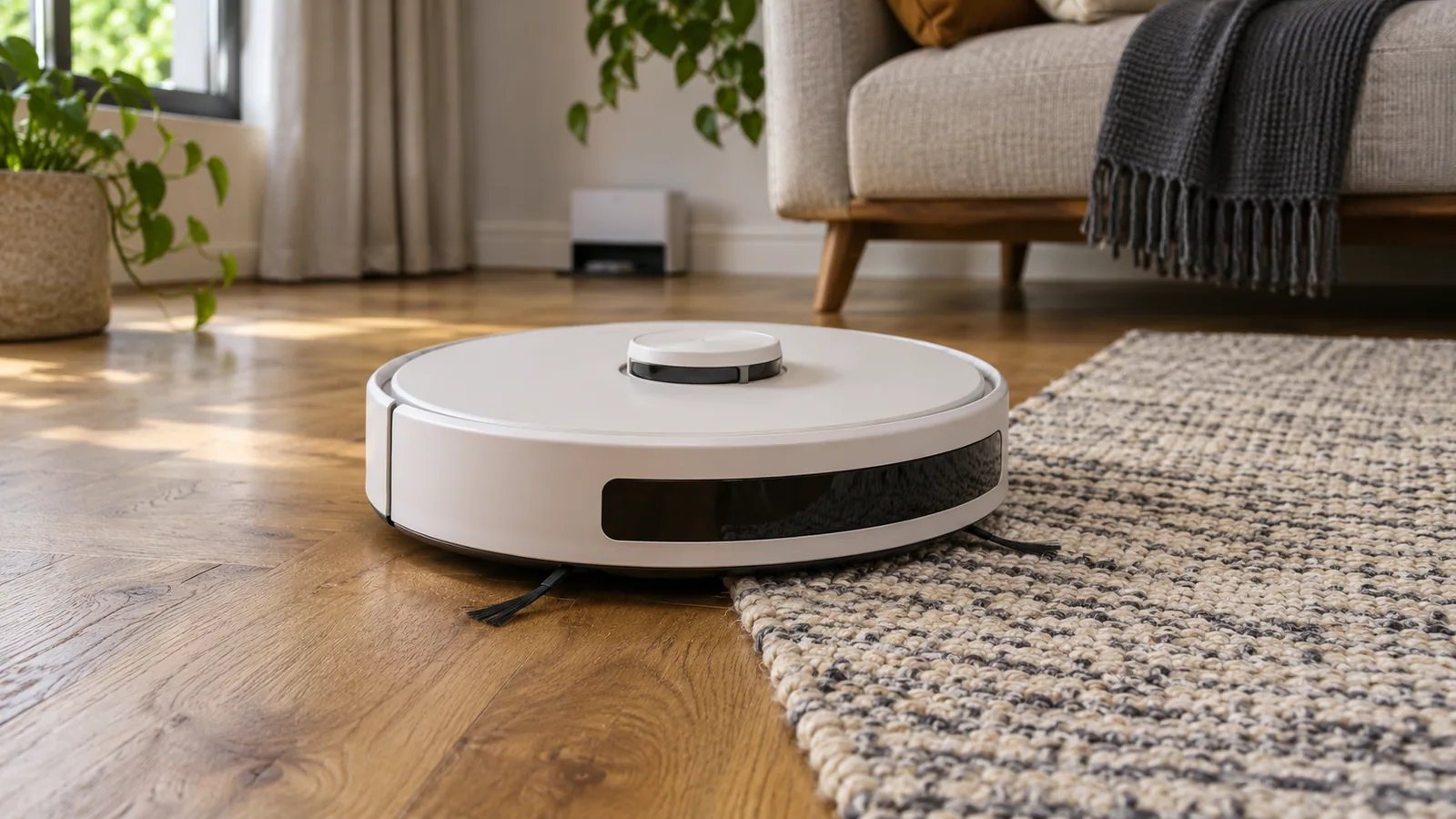
The short version
- Measure thresholds, furniture clearance and dock space before comparing suction figures.
- A full dock reduces daily handling but adds tanks, bags and brushes to maintain.
- Mop lifting helps on short-pile rugs; delicate or high-pile rugs still need a no-mop zone.
- Check the app for room maps and no-go zones, not just the longest feature list.
A robot vacuum is a small vehicle that has to find its way around your home, clean the edges of a room and get back to a dock without help. That is a harder job than the adverts suggest, and it is why two robots with the same suction number can perform very differently in two homes.
The useful way to choose one is to start with the floor plan, then the dock, then the maintenance. Suction comes last, because almost every model in the current generation has enough of it for a normal home. What separates them is whether they can reach the dirt and whether you are willing to keep them running.
Measure the home before comparing models
Walk through the rooms at floor level with a tape measure. Note the things a robot has to cross or avoid:
- Door thresholds and raised transitions between rooms.
- The gap under sofas, beds and kitchen cabinets.
- Chair legs, table pedestals and floor lamps.
- Loose cables, rug edges and pet bowls.
- The wall space where the dock will sit.
The lowest clearance is the number that matters. A robot that is a few millimetres too tall will not go under the furniture you most want it to clean, and no amount of suction will fix that. The dock needs power, clearance for the robot to enter, and enough room to lift or open the water tanks.
Hard floors, rugs and the mop question
Most robots now vacuum and mop. On hard floors, a mop pad or a pair of rotating mops can keep a kitchen floor looking better between deep cleans. On rugs, the mop becomes a liability unless the robot can lift the pad or you can mark the rug as a no-mop zone.
Mop lifting helps with short-pile rugs. It does not make a wet mop safe for a wool rug, a high-pile rug or anything delicate. The reliable approach is to use the app's no-mop zones for those rugs and let the robot mop the hard floors around them.
If your home is mostly carpet, a vacuum-only robot is simpler and usually cheaper. Paying for mop hardware you will not use adds maintenance without adding cleaning.
The dock changes the ownership experience
A full dock can empty the dust bin, wash the mop, refill the water tank and dry the mop. That reduces the daily handling, but it does not make the robot maintenance-free. It moves the maintenance to the dock.
Before choosing a dock, check:
- The size and height of the dock, and whether it fits the wall you have.
- Whether it needs a water supply or just a tank you refill by hand.
- The cost and availability of dust bags, filters and mop pads.
- How the dirty water tank is emptied and cleaned.
A large dock in a small flat can take up more space than the robot saves. A smaller robot without a self-emptying dock can be the better fit if you are happy to empty the bin every few days.
Navigation, maps and obstacle avoidance
Room mapping, schedules and no-go zones are set in the app. Look for the features you will actually use: multi-floor maps if you have stairs, room selection if you want to clean the kitchen after dinner, and no-go zones if there are cables or pet areas to protect.
Obstacle avoidance is assistance, not a guarantee. Small objects, cables, pet waste and difficult lighting can still cause problems. The first few runs are a test: pick up what you can, watch where the robot struggles, and adjust the map rather than expecting the software to learn everything.
Brushes, hair and filters
Hair wraps around brushes. Rubber brushes and anti-tangle designs reduce the problem, but they do not eliminate it. Check how easy the brush is to remove and clean, and whether replacement brushes and filters are easy to buy.
A washable filter needs to dry completely before it goes back in. A damp filter reduces suction and can smell. If you have pets, budget for more frequent filter cleaning and replacement.
Who a robot vacuum suits
A robot vacuum suits a home with a lot of hard floor or low-pile carpet, a place to put a dock, and someone willing to do a little maintenance. It is a maintenance tool, not a one-time purchase that runs forever.
It suits less well if the home is mostly high-pile carpet, if there are many thresholds or tight spaces, or if nobody wants to clean the dock and brushes. In those homes, a good cordless stick vacuum may be more useful for the same money.
Before you buy
Measure the clearance and the dock space. Decide which rugs need a no-mop zone. Check the app features and the cost of consumables. Read the return policy, because a robot that cannot navigate your home is difficult to live with.
Then compare models on the things you cannot change later: height, dock size, mop lifting, and the availability of parts. Those matter more than the largest number on the box.
Sources
- Roborock US: Qrevo Edge 3 Pro — Model overview used for dock and navigation context
- iRobot support: obstacles and thresholds — General guidance on floor prep and obstacles
Keep reading
How to Add Streaming to a Hi-Fi You Already Own
A streamer can give an older amplifier access to Spotify, AirPlay and high-resolution files. Here is what to check before you buy one.
Portable Power Stations: What Wh and W Actually Tell You
A 2,000 Wh battery is not a 2,000 W appliance. A practical comparison of small and large stations, and the maths that decides which one you need.