Portable Power Stations: What Wh and W Actually Tell You
A 2,000 Wh battery is not a 2,000 W appliance. A practical comparison of small and large stations, and the maths that decides which one you need.
Affiliate disclosure: This guide contains no active affiliate links.
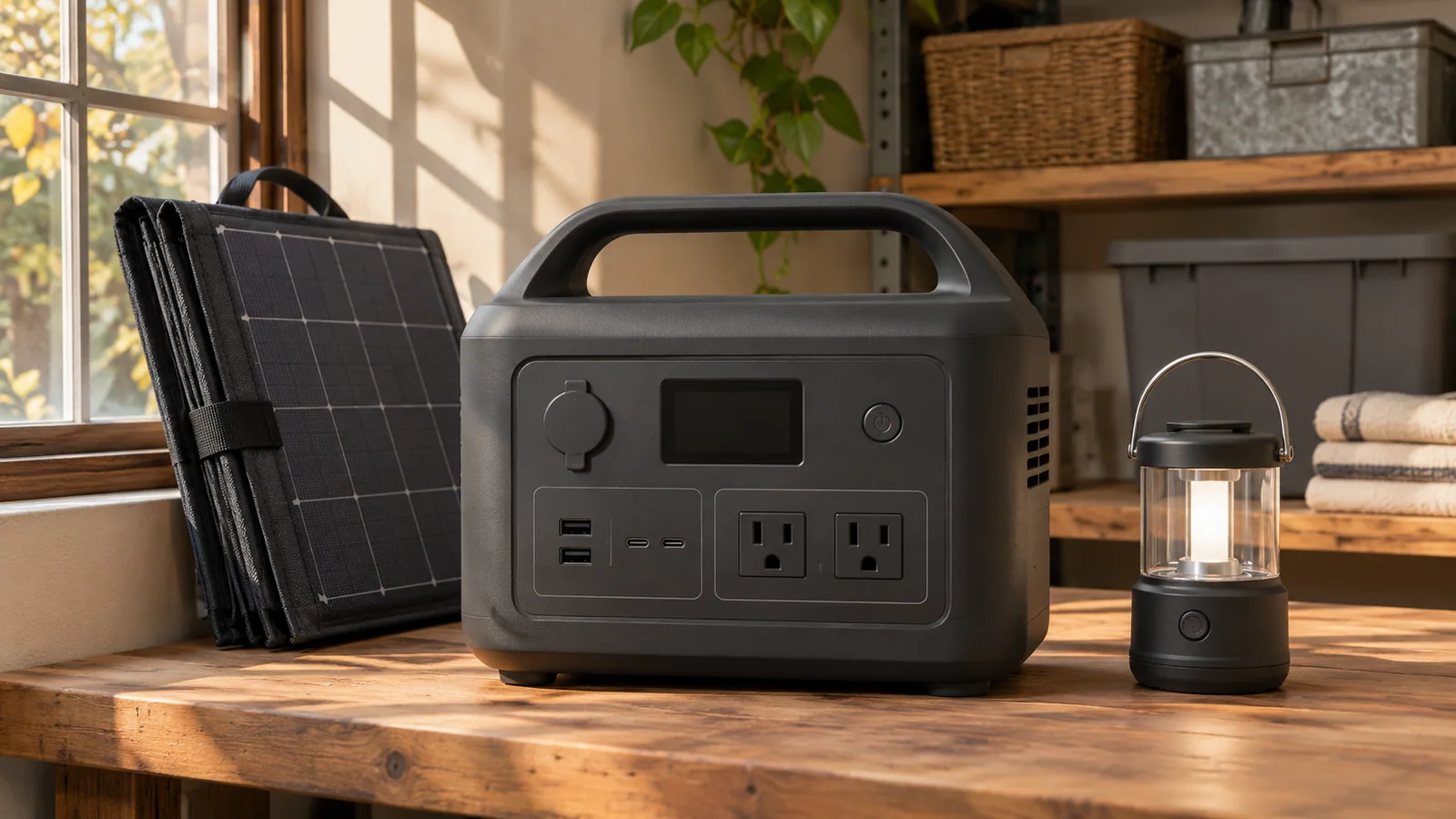
The short version
- Watt-hours measure stored energy; watts measure how fast you can draw it.
- Add up the devices you need at the same time to find your peak load, then add a margin.
- Solar panels are rated at peak sun; real charging is slower and seasonal.
- A larger battery is not safer for a whole-home circuit without a transfer switch and an electrician.
Portable power stations are sold on two numbers that look similar and mean different things. Watt-hours (Wh) tell you how much energy the battery holds. Watts (W) tell you how fast the station can deliver that energy. Confusing the two is how people end up with a battery that runs a lamp for two days but cannot start a fridge.
This comparison works through the maths first, then looks at what small, medium and large stations are actually for. The example models are here to make the sizes concrete, not to suggest that one brand owns the category.
Wh and W in one paragraph
A 1,000 Wh battery can supply 1,000 W for one hour, 500 W for two hours, or 100 W for ten hours, ignoring losses. A station rated at 2,000 W can deliver that much power at any moment, but it will empty a 1,000 Wh battery in about half an hour at full output.
So the two questions are separate. How much energy do I need? is answered in Wh. What is the biggest load I need to run at once? is answered in W.
Build a load list before comparing stations
Write down each device, its running watts and the hours per day you need it. Then multiply.
| Device | Running watts | Hours | Watt-hours |
|---|---|---|---|
| Wi-Fi router | 10 | 24 | 240 |
| LED lamps (three) | 20 | 5 | 100 |
| Phone charging | 10 | 3 | 30 |
| Laptop | 60 | 4 | 240 |
| Small fridge (compressor cycling) | 60 W while running | 8 h running | 480 |
| Total | 1,090 Wh/day |
That is a realistic small-outage list: communications, light, work and food. It needs about 1.09 kWh per day, plus a margin.
For the fridge row, the 60 W is the power drawn while the compressor runs, and the 8 h is the total running time in a day. If you only know a daily average, multiply that average by 24 h instead; do not mix the two methods. Fridge cycling varies with room temperature and how often the door is opened.
The peak load is separate. Add the watts of the devices you might run at the same time. In the list above, the router, lamps and laptop together are about 90 W, well within any modern station. A kettle or a space heater is a different story: 1,500 W for ten minutes is 250 Wh, but it also sets a 1,500 W floor for the station's output rating.
Usable capacity is lower than the label
Battery capacity is not the same as delivered energy. Inverter losses, the station's own electronics and the way lithium batteries behave near empty all take a share. As a planning assumption — not a manufacturer guarantee — treat 80–85% of nominal capacity as usable, and less in cold conditions.
At 2,080 Wh nominal, the BLUETTI Elite 200 V2 works out to roughly 1.66–1.77 kWh under that assumption. Against a 1.09 kWh daily load, that is about a day and a half, not two full days. It is still a useful amount; it is just not the number on the box.
Surge is the number people forget
Motors and compressors draw a surge when they start. A fridge that runs at 60 W might draw several hundred watts for a moment. A sump pump or a circular saw can draw far more.
Check the station's continuous and peak output, and compare the peak with the startup draw of anything with a motor. If the station trips when the fridge starts, the battery is not necessarily empty; the inverter is protecting itself.
Solar input is a peak rating, not a daily promise
A 200 W solar panel is rated at peak output under standard test conditions. In real use, the angle, shade, clouds and season reduce that. Actual charging power also depends on the station's input limits, not only on the panel's wattage.
Solar compatibility has to be checked against the specific model's manual: the allowed input voltage range, maximum current, maximum power and connector type. A panel can be within the wattage but outside the voltage or current window, or use a connector the station does not accept. If the manual does not state that a particular panel or parallel/series combination is supported, do not assume it is; plan on wall charging as the reliable fallback.
Small, medium and large: what each class is for
| Class | Typical capacity | What it suits | What to check |
|---|---|---|---|
| Small | 300–600 Wh | Phones, router, lamps, a laptop for a day | Output rating, USB-C PD, weight |
| Medium | 1,500–2,500 Wh | A short outage with a fridge, router and lights | Continuous and surge output, fridge startup |
| Large | 3,000 Wh and up | Multi-day outages, solar charging, power tools | Weight, solar input limit, storage space |
The BLUETTI Elite 200 V2 is listed on the US product page at 2,080 Wh with a 2,600 W AC output, which puts it in the medium class. The Elite 300 bundle page lists 3,014 Wh and 2,400 W AC output and pairs the station with two 200 W solar panels, which puts it in the large class. Those figures come from the manufacturer's US product pages; check the current listing and the manual before relying on them for a specific installation, especially the solar input limits.
Weight, storage and the reality of moving it
A large station is heavy. Check the weight before you plan to carry it up stairs or lift it into a car. A medium station on wheels is easier to live with than a large one that stays in a cupboard.
Storage temperature matters too. Lithium batteries do not like being left in a freezing garage or a hot car. Follow the manufacturer's storage guidance, and charge the battery to the recommended level before long storage.
Safety: what a portable station is not
A portable station is not a whole-home backup. It can run extension leads and individual appliances. Connecting it to household wiring requires a transfer switch installed by a qualified electrician, and back-feeding a circuit is dangerous.
Do not run a petrol generator indoors, and do not treat a battery station as a substitute for smoke alarms, a fire plan or medical equipment with its own backup. For anything that keeps someone alive, use equipment designed and certified for that purpose.
Which one to buy
If your outage plan is a router, lights, phones and a laptop, a small or medium station is enough, and the money is better spent on a second charging option than on extra capacity.
If you need to keep a fridge running for about a day, aim for the medium class and check the surge rating. For longer coverage, size the battery from your own load list rather than assuming a class will cover it. If you want multi-day coverage and plan to recharge from solar, the large class makes sense, provided you have somewhere to store it and a realistic idea of winter solar output.
Before you buy
Add up your load list in Wh. Check the peak watts against the devices with motors. Compare usable capacity, not just the label. Confirm the solar input limit if you plan to charge from panels. Check the weight and the warranty, and read the manual for the charging temperature range. Those five checks will tell you more than any single number on the product page.
Sources
- BLUETTI US: Elite 200 V2 portable power station — US model page: 2,080 Wh capacity, 2,600 W AC output
- BLUETTI US: Elite 300 with two 200 W solar panels — Bundle page: 3,014 Wh capacity, 2,400 W AC output, two 200 W panels
- U.S. EIA: Measuring electricity — Watts as power, watt-hours as energy over time
Keep reading
How to Add Streaming to a Hi-Fi You Already Own
A streamer can give an older amplifier access to Spotify, AirPlay and high-resolution files. Here is what to check before you buy one.
Choosing a Robot Vacuum for Hard Floors and Rugs
Suction is the easiest number to advertise and the least useful one to compare. Start with clearance, dock space and how the mop handles a rug.